The British Army Fitness Test
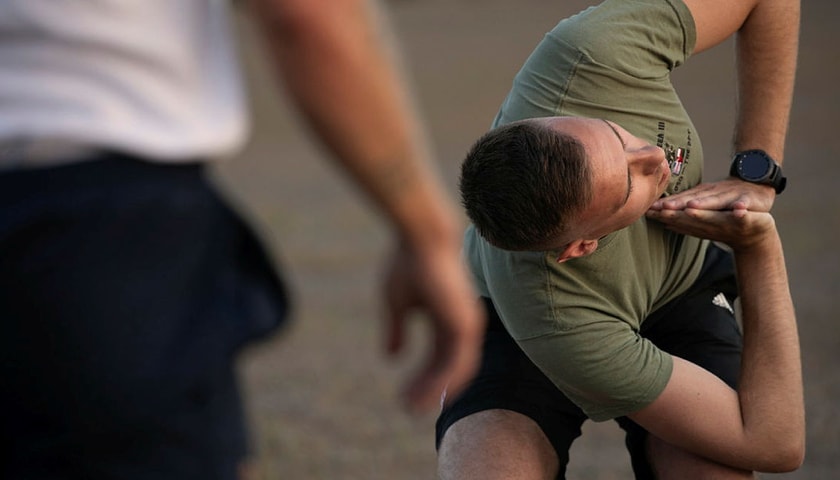
It should come as no surprise that British Army soldiers must be incredibly fit in order to perform their demanding and sometimes dangerous roles. An effective fighting force must be able to carry all their gear, rescue the wounded, and handle a range of equipment, weapons, and tools under pressure and for long periods. Even in peacetime, the armed forces are often involved in physically demanding relief or humanitarian work.
The British Army Fitness Test sets the benchmark by which soldiers are measured. This includes sign-up tests at the recruitment stage so that only the very best are eligible to join, and annual fitness tests to ensure these high standards are maintained.
See our article on how you can improve your own fitness with our list of essential workout and fitness skills.
The British Army Fitness test is also a truly equal opportunities test, with no allowances made for gender.
When did the British Army start testing fitness?
The British Army physical fitness standards have evolved over more than 150 years. The Royal Army Physical Training Corps (RAPTC) began in 1860, following the Crimean War. Back then, it was called the Army Gymnastic Staff, and later the Army Physical Training Staff.
In 1940 (during the Second World War), this developed into the Army Physical Training Corps, and in 2010 the title was amended with ‘Royal’.
A BBC article about the history of the Second World War includes a quote from a soldier named Eric Annable.
One thing the Army were very keen on and was Physical Training. We used to go on cross-country runs, and were expected to go for boxing and any sort of exercise.
British Army Fitness Sign-up test
When applying to join the British Army, one of the first things a prospective soldier must do is pass a physical examination and the fitness test. The fitness test measures both endurance and strength.
Beep test
You have probably heard of the beep test, and you may even have taken part in one. This test measures endurance and aerobic capacity. Candidates must run between two lines 20 metres apart and keep up with the beep. If you can’t make the distance between two beeps, you’re out.
Levels which you need to meet are based upon the role which you wish to undertake. The physical standards to join the infantry are higher than many other roles.
Medicine Ball Throw
The Medicine Ball Throw measures explosive upper-body strength. To take the test you must sit with your back against a wall and throw a 4kg medicine ball as far as possible. The test measures your best throw after three tries. The minimum standard for all army roles is 2.7 metres with some roles requiring a throw distance of 3.1 metres.
Mid-Thigh Pull
The mid-thigh pull measures lower body strength. In this test, you must lift a hex-bar for 5 seconds with at least 50kg. Your best score will be counted from two attempts.
Different roles in the army have different requirements. More physically demanding roles will require greater strength and endurance than others. Army Reserves are also measured against different standards. For example, regular combat infantry must do the beep test to level 8.06, throw the medicine ball 3.1 metres, and lift 76kg on the mid-thigh pull. Reserves need to reach level 5.08 on the beep test, throw the medicine ball 2.7 metres, and lift 50kg with the mid-thigh pull.
Annual Fitness Test
Once employed, every soldier must maintain a certain level of fitness so that they can continue to perform their role properly. These tests include the Soldier Conditioning Review (SCR) which is to be completed every 6 months and the Role Fitness Test (RFT) which is to be completed once a year. Both tests have varied requirements for different roles to meet. For example, Ground Close Combat (GCC) troops will have to maintain a higher standard of fitness compared to Non-Ground Close Combat soldiers (N-GCC).
The Solider Conditioning Review (SCR) will measure all round conditioning and includes similar activities to the entry standard testing, with the addition of:
- Broad Jumps – to measure lower limb explosive power
- Heaves and Press-ups – pull ups to measure upper body strength
- 2km run – to measure sustained aerobic activity
The Role Fitness Test (RFT) passing threshold will be determined by role and is based around military movement, those in GCC roles will be required to carry more weight and complete certain activities faster than those in N-GCC roles. These activities will reflect the essential, most physically demanding tasks that could be required in military service and will include:
- Loaded March with weight – A 4km tab carrying weight, followed by a 2km run with reduced weight
- Casualty Drags – Pulling a weighted bag over 20m
- Water Can Carry – Carry 2 x 22kg water cans over 240m
- Vehicle Casevac Pull – 70kg lift for 3 seconds
- Lift & Carry – Life 20kg bags 20 times over 30m
- Fire & Movement – numerous 7.5m bounds, followed by a 15m crawl
The British Army’s approach to physical fitness is a continually evolving and rigorous system designed to ensure that every soldier is capable of meeting the demanding requirements of their role. By establishing clear, role-specific, and gender-neutral standards, the British Army guarantees that its personnel maintain the high levels of strength and endurance necessary to be an effective and resilient force.
Go further with Army Cadets
Keeping active is a core tenet of the Army Cadet Syllabus, along with other skills like fieldcraft, first aid, and more. If you want to push yourself further, make new friends, and overcome new challenges, find your nearest detachment today and show us what you can do.
Image credit: https://www.army.mod.uk/