History of British Military Bands
Origin of Military Music
Music has been an essential element of military practice for thousands of years; one of the oldest examples of music on the battlefield comes from the Bible in the Book of Joshua.
Long before signals technology like WiFi, radios and satellites became commonplace, generals needed to be able to command and control their armies on the battlefield. The answer was music. Drums and trumpets allowed massed units of rank and file troops to work together, listening for the rhythm of the march, or orders to manoeuvre. Music on the battlefield made communication and coordination possible, and boosted morale.
Music in the British Army
The Royal Artillery Band is the oldest military band in the British Army, with roots going all the way back to 1557 during the Battle of St. Quentin. Later, King Charles II took inspiration from French military music while observing the French Army under King Louis XIV. After returning to the throne, he introduced French-style music to the British military. In 1678, the Band of the Horse Grenadier Guards began using six hautbois (early oboe) instruments, and by 1690, most British Army regiments had adopted these instruments too.
17th to 19th centuries
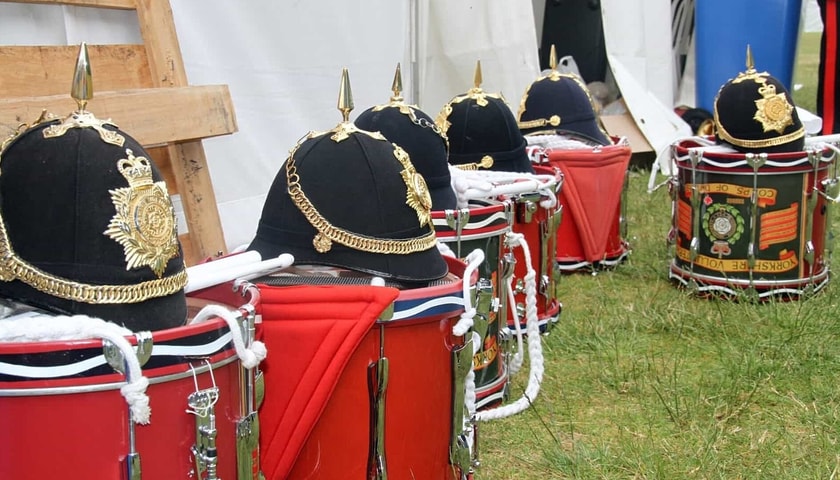
In the 17th and 18th centuries, soldiers marched to the sound of drums. Many drummers were teenagers when they joined the army. They had more than just musical duties – they were often tasked with carrying out punishments, such as flogging soldiers who had been sentenced to a whipping. For nearly 200 years, the Artillery Band consisted only of “drums and fifes” until it was made an official band in 1762.
Regimental bands for the Foot Guards were established a short time later, between 1783 and 1785. The 1st Foot Guards Band became known as the Duke of York’s Band, while the 3rd Foot Guards Band was called the Duke of Gloucester’s Band.
In the corps of drums within line infantry units, fifes and drums had been used for centuries. However, starting in the 1850s, bugles began to replace or complement these instruments in such formations. Up until 1837, Army bands also featured the Turkish crescent, a distinctive percussion instrument introduced in the 18th century, inspired by the Ottoman Empire and its military band traditions.
Royal Military School of Music
During the Crimean War in 1854, a special parade was held in Scutari (modern-day Turkey) to celebrate Queen Victoria’s birthday. During the event, twenty British Army bands performed the national anthem, God Save the Queen. However, the bands played it in different key signatures and with varying instrumentations, leading to a somewhat chaotic performance. To address this, in 1857 the Royal Military School of Music was established at Kneller Hall to provide proper training and standardisation for all musicians in the army’s bands.
20th century
By the early 20th century, regimental infantry and cavalry bands in the British Army were highly skilled and versatile, though their battlefield role had diminished due to advancements in technology. Bugle and trumpet calls were still used on the battlefield in the early 1900s to give signals, but bands were primarily reserved for ceremonial occasions.
During the First and Second World Wars, bandsmen took on vital non-combatant roles such as stretcher bearers, dispatch riders, and other support duties. Field musicians often joined combat support units or heavy weapons teams. However, as the size of the army was reduced, maintaining regimental and battalion bands became financially unsustainable. These bands, once symbols of British military culture, began to be seen as an economic strain. Similar reductions affected the Royal Navy (including the Royal Marines) and the Royal Air Force, even though both services had established their own schools of music in 1902 and 1918, following the army’s lead.
During the Second World War, the need for women in the armed forces led to the creation of all-women military bands in each service branch. While these bands no longer exist, since 1991, all British Armed Forces bands have included both male and female musicians, reflecting the modernisation of military music.
In 1947, some key military bands, such as the Royal Artillery Mounted Band and the Portsmouth and Salisbury Plain bands, as well as the bands of six larger Corps, were granted the status of staff bands and were based in permanent locations. However, in 1984, four staff bands were disbanded, and the remaining bands were significantly reduced in size. This particularly affected regimental and battalion bands, which were cut down to just 21 musicians each. Infantry regiments with three battalions often opted to maintain two bands of 35 musicians instead, adapting to the reduced resources.
Military Bands Today
Today, the UK still operates several military bands, although, as their importance on the battlefield has dwindled, their roles are now ceremonial. The Royal Corps of Army Music controls the British Army military band today, which consists of five regimental bands: The Irish Guards, Welsh Guards, Scots Guards, Coldstream Guards, and Grenadier Guards
The UK’s military bands became the basis for much of the former British Empire and Commonwealth nations, so the traditions established by the British Army can now be seen in military bands all around the world.
Go further with Army Cadets
The Army Cadet Syllabus includes a whole section on music, including Military Bands, the Corps of Drums and Bugles, and Pipes and Drums. If you love music and want to explore your passion while you make new friends, find your nearest detachment today and show us what you can do. There is also the opportunity to take part in national musical events with Army Cadets, such as the Rorkes Drift Concert, and the annual Military Music Spectacular.
Image credit: Monica Volpin