Battle of Rorke's Drift
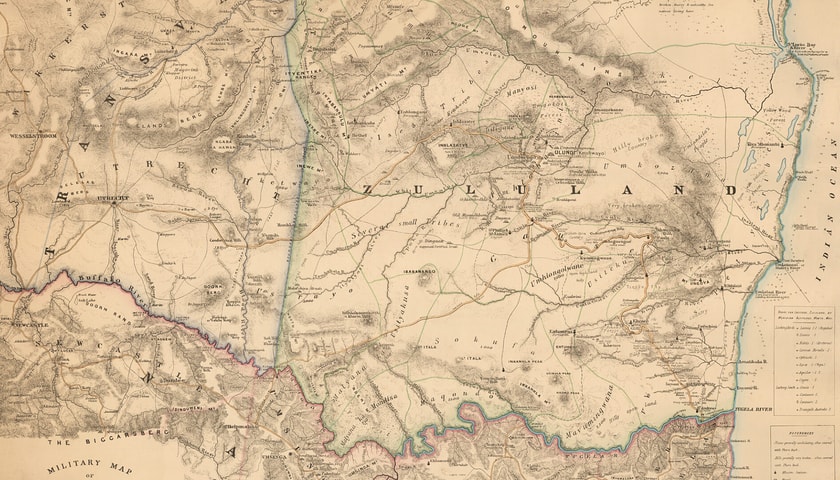
The Battle of Rorke’s Drift took place on 22 January 1879 in Zululand, South Africa. It was part of the Anglo-Zulu War, occurring only days after the war began. Rorke’s Drift is celebrated as one of the most extraordinary victories in military history, where just over 150 British troops triumphed against an estimated 3,000 to 4,000 Zulu warriors.
Background to the Zulu War
The Zulu War began eleven days earlier, against the wishes of the British Government. Sir Bartle Frere had been dispatched to South Africa as High Commissioner with the intention of extracting the area’s natural resources. Sir Frere instead ended up sending an ultimatum to King Cetshwayo of the Zulus, which was rejected.
Rorke’s Drift
Rorke’s Drift, situated near the banks of the Buffelsrivier, approximately 100 miles north of present-day Durban, was originally a trading post established by James Rorke. It had since become a Swedish mission station intended as a base of operation for missionaries to preach throughout the region. By the time of the war, its two single-storey buildings had been converted into a hospital and a storehouse.
The mission station was at this time occupied by Lt. Gonville Bromhead and his company, as well as 100 Natal Native Contingent troops, but Lt. John Chard had been dispatched from the main army before the battle of Isandlwana began with orders to make defensive preparations at Rorke’s Drift, and as the senior officer, he took command.
The First Zulu Battle
The first real battle of the war was the Battle of Isandlwana, which also took place on the 22nd of January, where the British were defeated by an army of 20,000 Zulu warriors. Toward the end of the battle, about 4,000 warriors who had not engaged in the fighting moved to cut off the British retreat. Once complete, they crossed the river and turned their attention to Rorke’s Drift and its 140 soldiers, civilians, and patients.
Battle of Isandlwana Survivors Bring News
Two survivors of the Battle of Isandlwana arrived at the mission station after noon on the 22nd and warned the men stationed there that Zulu forces were approaching. The officers had a meeting to decide their course of action. They decided that to leave would be out of the question. They would be outnumbered, in open country, and burdened by the wounded. They chose to stay and fight.
At this point, the defenders numbered nearly 500 thanks to the assistance of native contingents of infantry and cavalry, but this soon changed. The cavalry, numbering about 100 native troops who had retreated from the Battle of Isandlwana, took position on the far side of a large hill from where the Zulus were expected to approach. Meanwhile, in the camp, fortifications were erected from biscuit boxes, as well as mealie bags weighing over 90 kg.
Despite this, or perhaps understandably, fear of the approaching army spread through the camp. As the battle approached, the Swedish missionary assigned to the station, Otto Witt, fled with his companions. The cavalry troops briefly engaged the Zulus for the second time that day, but also turned and ran. When the Zulu army was finally spotted, the remaining native contingent also fled.
All that remained were a little over 150 men, almost 40 of whom were already wounded.
The Defence of Rorke’s Drift
The first assault on the mission station began about 4:30 p.m., when around 600 Zulus attacked the south wall while most of the Zulu forces approached from the north. The majority of the Zulus were armed with spears and hide shields, with some armed with rifles and muskets. The British were armed with modern rifles, the Martini-Henry breech-loader, and 20,000 rounds of ammunition. The British opened fire when the attackers had approached to within 500 metres, to maximise their chance of hitting.
Vastly outnumbered, the British soldiers were not able to repel the attack with rifles alone, and the Zulus quickly approached close enough for hand-to-hand combat. Fortunately, the mission’s high walls prevented the Zulus from quickly overwhelming the defenders, but the British couldn’t push back the attack.
Fight at the Hospital
Around 6:00 p.m., Lt. Chard gave the order to abandon the defence of the north wall and pull back into the yard. This left two rooms of the hospital, which shared the wall, unguarded. Although loopholes had been made in the hospital wall, these were proving useless with so many attackers at close quarters. The Zulus either snatched at British rifles through the holes or used them for their own rifles.
Two hospital patients were dragged through the central room into a corner room by the soldiers, but there were ten men in the corner room — nine of them patients.
Private John Williams hacked through another wall as the Zulus attacked the door for almost an hour, all whilst the building burned, but he succeeded in breaching another wall while Private Alfred Hook held the door. In the end, the work of these Privates saved nine lives. Only two were lost.
Last Stand
Once the hospital had been lost, the defenders retreated to the far end of the mission. Their perimeter was now smaller, and the barricade of biscuit boxes became a last line of defence. The Zulus continued their constant harassment into the night, but the defenders held. From midnight through to pre-dawn, the attacks lessened.
As the sun rose, the British prepared for another attack, but the Zulu attackers had gone, leaving behind the dead and wounded.
Around 7:00 a.m., the Zulus were spotted again, but they were retreating. After ten hours of hard fighting, the British had won. They had 900 rounds of ammunition left.
Rorke’s Drift Victoria Medal Winners
The survivors were rightly commended, and eleven Victoria Crosses were ultimately awarded to the soldiers — the most ever awarded for a single action by one regiment. Had posthumous Victoria Crosses been possible in 1879, this number could have been even higher. Private Joseph Williams, who was killed in the fighting, was noted in reports as having been recommended for the award, had he lived.
The ultimate recipients were as follows:
- Lieutenant John Rouse Merriott Chard
- Lieutenant Gonville Bromhead
- Corporal William Wilson Allen
- Private Frederick Hitch
- Private Alfred Henry Hook
- Private Robert Jones
- Private William Jones
- Private John Williams
- Surgeon-Major James Henry Reynolds
- Acting Assistant Commissary James Langley Dalton
- Corporal Christian Ferdinand Schiess
Go Further With Army Cadets
Teamwork and organisation were key elements in the defence of Rorke’s Drift. The Army Cadets can teach you these skills and more, and you can make friends along the way.
Saturday 25th February 2025 is the 25th anniversary of the Rorke’s Drift Concert, due to take place in Theatr Brycheiniog in Brecon, Powys. Cadet musicians from across the UK will be joining the Gwent and Powys Army Cadet Force for this special one-night-only musical event. Book your tickets here.
To find out more about the Army Cadets and get involved, contact your local detachment today.