Cracking the Enigma Code
Secret codes and encrypted communications have been a part of war for centuries, with the oldest known dating back to 400 B.C. Codes allow messages to be concealed and transmitted securely, which, in a war, is vital because if the enemy knows your plans, they can react accordingly.
During the darkest days of World War II, the German military relied on a seemingly invincible device to secure their communications: the Enigma Code machine. This electric typing machine generated messages that German commanders believed were utterly secure, giving them a devastating advantage in operations like the Battle of the Atlantic. The challenge for the Allies wasn’t just to win the war but to penetrate this wall of absolute secrecy. This monumental task fell to a secret group of thinkers, scholars, and eccentric geniuses gathered at a discreet country estate in Buckinghamshire: Bletchley Park.
Elements of a Secure Code
You can create a simple code by shifting letters, for example, replacing A with B, B with C, and so on. This produces a message that still corresponds one-to-one with the English alphabet but appears meaningless at first glance. However, such a code is easy to break because the underlying patterns of language remain the same, making it straightforward for someone to reverse-engineer the substitution. In general, pattern recognition is one of the most effective ways to break codes: once you identify the pattern, you can simply invert it to reveal the original message.
The goal is to increase the complexity of the encryption so that the key to unlock it, called the cipher, can’t be guessed or worked out. You could change letters and use another language, for example, or use numbers to add more complexity.
It is also possible to make unbreakable codes, but these can only be used once, and there is little value in having to create a new code every time you send a message.
The ideal solution is a code which is both complicated and constantly changing, but is also easy for your friends and allies to read.
What Was the Enigma Machine?
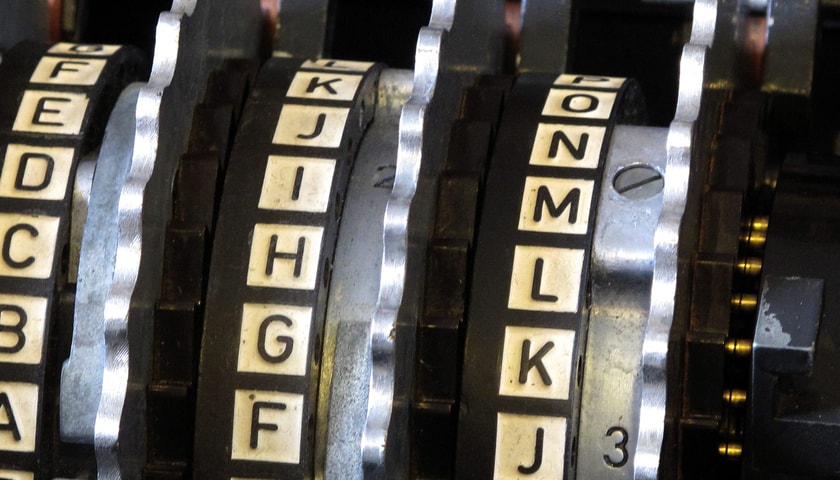
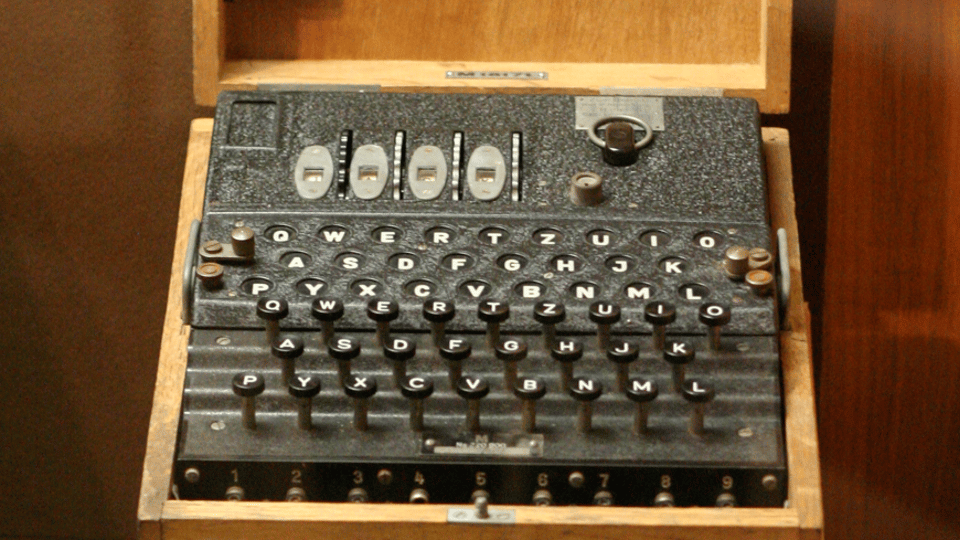
The Enigma Code was terrifyingly effective because of its mechanical complexity. It looked like a complicated typewriter, but its internal workings were a masterpiece of engineering designed for cryptographic perfection.
The machine used three core components to scramble a message:
Rotors (Scramblers)
Initially there were three wheels (later naval models included eight), each containing 26 electrical contacts. When a key was pressed, the electric signal passed through these three rotors, which rotated after every letter, constantly changing the encryption sequence.
The Plugboard (Steckerbrett)
This component added a final layer of complexity. Operators could manually switch pairs of letters (e.g., connect A to J, and J to A) before and after the signal hit the rotors. This step alone increased the number of possible settings by many millions.
The Reflector (Umkehrwalze)
This component sent the signal back through the rotors using a different route, ensuring that if you typed ‘A’ you got ‘Q’, but if you typed ‘Q’ you got ‘A’.
The result of this layering meant that the number of potential daily key settings, the daily Enigma Code key, was greater than 158 million million million! To break this, the Allies couldn’t just guess; they needed a systematic, revolutionary approach.
The Bletchley Code Breakers
While Bletchley Park is famed as the ultimate hub of code breaking, the true beginning of the solution lies further east, in Poland. The crucial foundational work, often tragically overlooked due to the subsequent secrecy, was carried out by the brilliant Polish mathematician Marian Rejewski.
Starting in the early 1930s, Rejewski and his team at the Polish Cipher Bureau used pure mathematics to reverse-engineer the Enigma machine’s wiring without ever seeing one. They developed an electromechanical machine called the Bomba (named after a type of ice cream) to test potential settings.
As war became inevitable, the Polish team understood the strategic importance of their findings. In a crucial meeting in Warsaw just weeks before the German invasion of Poland in July 1939, they shared their complete knowledge, including the mathematical models and the designs for their Bomba, with British and French intelligence. This act of intellectual generosity was absolutely vital; it gave the British code-breakers a massive head start. This became a precious gift of time that proved invaluable in the war effort.
The task of scaling this solution to handle the overwhelming volume of wartime German traffic fell to the Government Code and Cypher School (GC&CS), secretly housed at Bletchley Park.
The Bletchley code-breakers were an astonishingly diverse and unconventional group. Instead of relying solely on military expertise, they recruited brilliant minds in unexpected ways. Famously, the Royal Navy placed a cryptic crossword in the Daily Telegraph newspaper; champions who solved it rapidly were invited for interviews. The campus quickly swelled with mathematicians, chess masters, linguists, classicists, and even historians. It was a collection of some of the most eccentric minds Britain could find.
The work was divided into highly specialised sections, known by their ‘Hut’ numbers: Hut 6 focused on solving the German Army and Air Force Enigma traffic, while Hut 8 was dedicated to the even more complex German Naval Enigma. This massive, collaborative effort employed over 10,000 people by the war’s end, the vast majority of whom were women.
Alan Turing and the Enigma Code
The cornerstone of the British solution was provided by the genius of Alan Turing. A Cambridge mathematician with an incredible mind, Turing was given the task of creating a machine that could automatically search for the daily key setting, adapting the Polish Bomba concept.
Turing’s first major insight was identifying an operational flaw in Enigma itself: the reflector meant that a letter could never be encrypted as itself (A could not cipher to A). This seemingly small constraint dramatically reduced the number of possibilities and provided the lever needed for breaking Enigma.
He conceptualised and designed the British Bomba (later named simply the Bombe). This electromechanical behemoth was, in essence, a giant, relentless logical puzzle solver. Built by Harold Keen at the British Tabulating Machine Company, the first machine, named Victory, began operation in March 1940.
Breaking Enigma
Code breaking at Bletchley was a daily race against time that relied equally on human intelligence and Turing’s machinery.
The process was methodical:
- Cillies and Cribs: The vital human work began with guessing common phrases, known as “cribs.” Operators knew German discipline wasn’t perfect. Predictable messages (like weather reports, standard salutations, or the phrase “Nothing to report”) provided the code breakers with likely plaintext that matched a piece of intercepted ciphertext. This repetition made patterns easier to observe.
- The Bombe’s Work: The crib—perhaps a short sequence like WETTERBERICHT (weather report)—was wired into the Bombe. The machine then rapidly tested hundreds of millions of rotor settings and plugboard connections, attempting to find a scenario where the chosen crib could have produced the corresponding ciphertext. If the machine found a contradiction (such as A encrypting to A), it eliminated that entire setting.
- The Stop: When the Bombe found a combination that seemed mathematically consistent, it would “stop.” This meant the operators had found a handful of highly probable key settings.
- Final Testing: Human analysts would take these few settings and run them on a simplified Enigma replica, revealing the plaintext and delivering the intelligence.
By the end of the war, Bletchley had built over 200 Bombes, collectively running 24 hours a day, effectively reading vast amounts of German high-level communications in near real time.
Once decoding was complete, the messages would be handed off to MI6 for evaluation and dissemination.
The Impact and Legacy
The intelligence derived from breaking Enigma was code-named Ultra. This was not simply helpful information, it was strategically essential and decisive.
During the Battle of the Atlantic, Ultra provided the locations and routes of the U-boat “wolf packs.” This intelligence allowed Allied convoys carrying essential food and supplies to the UK to be rerouted around danger, saving countless ships and lives. Many historians estimate that this intelligence shortened the war by at least two years.
The ultimate tragedy is that, due to decades of mandated secrecy (the work was only declassified in the 1970s), the Bletchley code breakers—especially pioneers like Alan Turing—were prevented from receiving the recognition they deserved during their lifetimes. Yet their work, particularly Turing’s theoretical and mechanical framework for the Bombe, is recognised today as laying the fundamental groundwork for the development of the modern computer, modern cryptography which protects privacy and commerce on the internet, and the entire digital age. The team at Bletchley Park didn’t just win a secret war; they propelled the world into the future.
Go further with the Army Cadets
If you want to go further, the Army Cadets offers a unique opportunity for personal challenge and growth. The modern role of communications, cryptography, and cyber security is part of the Communication and Information Systems module of the Army Cadet Syllabus. Find your nearest detachment today.
Images licenced under Creative Commons

