An Interview With The UK Bobsleigh Team
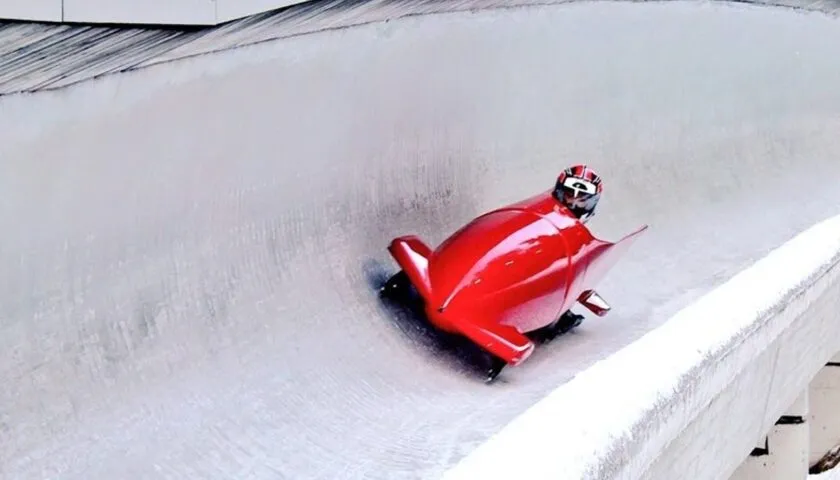
Bobsleigh is one of the most dangerous and thrilling of all the winter sports. We spoke to three athletes from BBSA (British Bobsleigh and Skeleton Association) to find out what it’s like.
There can be few sensations on Earth that equal a run in a bobsleigh. Squeezed into a steel pod, competitors negotiate a series of wickedly steep bends as they plunge down a course of glazed ice at breakneck speed. They hit the biggest bends at more than 80mph and 5G – five times the force of gravity.
Éire Rowland-Evans
One student who knows all about the exhilaration of this high-octane sport is 18-year-old Éire Rowland-Evans, who is part of the BBSA crew.
‘My first time on ice was mesmerising,’ says Éire, who was the former Lord Lieutenant’s Cadet for ACF Gloucestershire. ‘I instantly clicked with the speed and thrill of this adrenaline sport and have never looked back.’
Bobsleigh, of course, is not without its dangers (last year Éire broke her collarbone while competing) and the likes of a helmet, burns vest, and ice spikes are mandatory.
‘When you are the pilot of the sled you also need to memorise the track,’ she explains. ‘Every bobsleigh track is completely different, so you need to study all the corners very precisely in order to slide fast and safely. One wrong move and you could crash.
‘You also need to pay attention to when you breathe on a bobsleigh corner: if you breathe at the wrong time, the G-force could break one of your ribs or cause you other damage. A pilot must consider all of this while sliding solo at anything between 80-120kph.’
Éire enjoyed plenty of sporting opportunities while at school and with the ACF. At 16, she was the youngest England U18 tug of war captain, and she is also the National ACF record holder for both 200m sprint and 100m backstroke in swimming. All this stood her in excellent stead for the gruelling selection process to get into Britain’s bobsleigh youth squad.
Now in the senior squad, the Swansea University student’s short-term goals are to represent GB at European and World Cup races, but her big ambition is to represent Team GB at the senior level in the 2026 Winter Olympics in Italy. She also hopes to get into Sandhurst and join the British Army bobsleigh team.
Captain Jo Ellett
Jo represented the British Army bobsleigh team for four seasons before stepping onto the international circuit. She began as a brake-woman but was quickly moved to the front seat and has taken on pilot duties ever since. She manages the team, administration and finances, but on the track, it’s quite a different story.
‘Your role is to get a 170kg-plus sled from the top to the bottom of the mountain as fast as possible,’ says Jo. ‘That comes with a lot of responsibility because when you are in a two-man/woman bobsleigh, you have another person’s life in your hands.’
Jo, who is Operations Officer at 1 Royal School of Military Engineering, has fond memories of trying out new sports and activities as a cadet at City of London and North East Sector ACF. Her advice to other cadets is:
‘Believe in yourself and you can achieve great things. Grab opportunities when they present themselves; otherwise, you’ll be the one to miss out. I never even dreamed of putting on a GB tracksuit but I put myself forward for the trials. Now I represent my country in an amazing sport.’
Jo is grateful for the encouragement the Army has given her, and she’s also worn the colours of the Corps of Royal Engineers in athletics, rugby and football. She encourages cadets with an interest in sport to take advantage of opportunities like STEM camps.
‘STEM is prevalent throughout bobsleigh: from understanding the mechanics of a sled and how it drives, the changing ice conditions and choice of runners, through to the finances of training and competing.’
Lance Sergeant Lamin Deen
Lamin is a double Olympian who competed in bobsleigh at both the Winter Games in Russia (2014) and South Korea (2018). According to Lamin, hours of preparation – both physical and mental – are needed in the run-up to every race.
‘Before you even get on the ice, you will have already rehearsed the run 30 or 40 times,’ he says. ‘In the minutes before you go down the hill, you’ll be going over it in your mind: the steers you’ll do, trying to recreate the pressure in the ropes you’ll be pulling and the position of your body when you make that turn – you could be 15 feet in the air at 80 miles an hour.’
A sergeant in the Grenadier Guards, Lamin didn’t set out to be an Olympian. He only got into professional sport through the Army.
‘There’s no way on earth I’d have had the opportunity to do it otherwise,’ diz ele. ‘I’ve been a full-time athlete since 2012, doing nothing but sport. There is no other organisation that will let you do that (even the Air Force and Navy aren’t as kind to their sport personnel) and push you all the way.
‘After the last Olympic Games, I was going to retire, and it was part order, I think (in a nice way), when I was told: “We think you should carry on because we know your potential.” With that kind of support and literally the whole Army behind you, it’s hard not to be successful.’
Lamin believes the resilience and teamwork learnt in the Army are great assets for a professional bobsleigh athlete. ‘You’ve got to be 100 per cent robust and have good camaraderie,’ he says. ‘In a practice run, you might crash at 90 miles an hour, but you still have to go back to the top and do it again. That takes a lot. It’s like having a car crash, getting out and jumping back into a different car and carrying on. And it’s not only yourself you have to think about: you have to motivate, encourage and nurture the other guys to do the same.’
Lamin encourages cadets to try sports they may not have thought about doing and says: ‘See what you like and give it a go. I never had any dreams of competing at bobsleigh. I used to love the film Cool Runnings, e the next thing I knew I was seeing the people who were in the movie. It was an opportunity I was given and I went for it.’