What I Learnt Climbing El Capitan
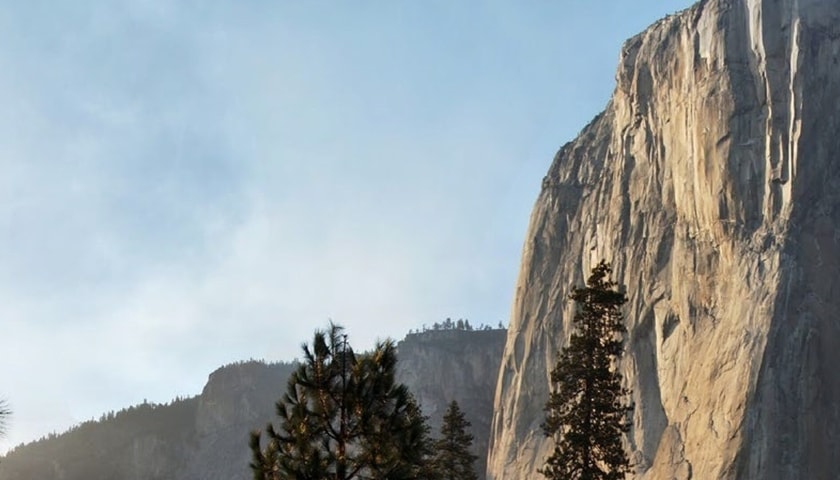
Ella Kirkpatrick was a regular 13-year-old kid from Sheffield with very little climbing experience when she became one of the youngest females to climb El Capitan, the iconic 1,000-metre wall in Yosemite National Park, USA.
Ella was accompanied by a team of five experienced climbers, including her dad, pro climber and mountaineer Andy Kirkpatrick, and ex-Royal Marine sniper Aldo Kane. The six-day adventure was recorded by CBBC.
How did you come to undertake such an astonishing feat?
At the time we did it, my dad had climbed El Cap 22 times (he’s now climbed it about 30 times, including doing it solo), and it was his signature mountain to climb. It’s a massive landmark; when you see it, you always know what it is.
We’d go to his talks and slide shows about his climbing adventures, and as we were leaving one of the shows, a fan came up and said, ‘When are you going to climb El Cap then, Ella?‘ and Dad said jokingly, ‘Oh, she’ll have to wait until she’s 13.’ But later in conversation, I asked him, ‘Could I actually climb El Cap?’ and he said, ‘You know, maybe that would be a good idea.’
Sometime after that, a filmmaker my dad knew suggested we do it as a TV programme with the idea of me climbing El Cap with Aldo Kane – the story being about the contrast between a 13-year-old girl and an ex-Royal Marine who were both climbing it for the first time. That fell through, as media things often do, but I pulled the “mum card” with Dad, saying, ‘It’s alright Dad, Mum said it wouldn’t have happened anyway because you’re unreliable,’ and he said, ‘Right, we’re going! ‘
We decided to do it by ourselves, but then it got picked up by CBBC. Then Aldo decided to come along too, so it was me, Aldo, my dad, Ben Pritchard (who filmed it) and my dad’s best mate Paul Tattersall. My mum said I could only go if Paul went too, as she knew nothing would happen to me if both my dad and Paul were there.
Did you have any worries about agreeing to do it?
No, I just thought it would be fun, and I was just thrilled to get a holiday out of it. I got three weeks off school, so I didn’t even care that it was going to be turned into a TV show. As a 13-year-old, I was just so excited to go to America and that my brother wouldn’t be there!
How much previous climbing experience did you have?
Little to none. Mum and Dad are divorced, and whenever we went to visit Dad in Scotland (where he lived when we were younger), we didn’t go climbing because his girlfriend at the time [Karen Darke, MBE, British Paralympic gold medallist and adventurer] was in a wheelchair, so it wasn’t something we did as a family. I’d led-climbed a route on a climbing wall, which is reasonably hard, but I’d really had very little experience at all.
What happened when you arrived in Yosemite?
We were there for about a week before we went up: we were scouting it out, shopping and regrouping. I asked Dad if we should go climbing to practise, and he said, ‘No, we’ll be fine,’ so in terms of what I did in preparation, it was nothing beyond trying out the gear.
We were on the mountain for six days in total. We slept at the bottom, climbed up [the group took the Tangerine Trip route], slept on portaledges [a hanging tent system designed for rock climbers who spend multiple days and nights on a big wall] for four nights, then camped at the top overnight before making our way down again.
It’s a notoriously difficult wall to climb…
Yes, it is, but El Cap isn’t vertical – it’s an overhang, so a lot of the time I was away from the wall. To climb it, you’d have to be one of those big climbers like Tommy Caldwell [Tommy made the first free ascents of several El Capitan routes]. My dad doesn’t even climb it. He does what’s called aiding – he puts the gear in and pulls himself up. So I let them put the gear in, and I climbed up the ropes, doing thousands of pull-ups to get to the top.
One thing we hadn’t counted on was how tired I’d be. I did minimal exercise at home (apart from a few clubs I went to) and was so physically exhausted between the pitches that I’d stop on the portaledge and have a little nap. There wasn’t really any hand-and-feet climbing except for the last pitch, which I wanted to do because I was sick of pulling myself up. My dad said afterwards, ‘You know that’s the most dangerous pitch for you to have climbed?’ and I just said, ‘Oh, that’s interesting.’
How did you cope with the fear when swinging hundreds of feet up in the air?
It was fine. In the TV show, they made a drama out of an incident where the rope got tangled under the portaledge, but in reality, it was okay because of the trust I had in my dad. My biggest fear was having to wee and poo on a mountain.
How does that work?
You’re still attached to your waist, but you pull your leg straps down and just have a wee into the abyss. And I did wee on my dad – and the cameraman … it was bound to happen. As the only girl, I thought the others had it easy.
The three men would camp in one spot, then Dad and I would camp on the pitch below (it’s not too safe to have all five on one anchor). But the one night I needed to have a poo turned out to be when all five of us camped together. It was pretty awful. Dad blasted some music, and I just had to put it into a bag. That was my lowest moment.
How did the team work together?
We were split into two camps. Paul and Aldo led, while my dad did a lot of the heavy lifting – he hauled up the bags and set us up. Ben and I were like buddies, moving up the mountain at the same time. We all had walkie-talkies to communicate with each other.
I don’t think Aldo had climbed a big wall like El Cap before, though he used to work on wind turbines, so he was used to heights. He was out of his comfort zone, though; the whole time, he seemed petrified. He enjoyed it afterwards, I’m sure, but I don’t think he did at the time.
I wish they’d made the me vs Aldo programme, as that would have been so interesting. I was so chilled, taking it in my stride as they lowered me out into the nothingness, floating 20 metres away from the wall. It was more difficult for Aldo because he had a harder job than me but also because of my age; I had total trust in everyone. I’d known them all – except Aldo – from birth, so I had a kind of blind ignorance, thinking, It’ll be fine.
You had to carry provisions for six days. What did you take?
Bagels, bagels and more bagels – and cream cheese. We were allowed to have a can of pop each day as it’s rehydrating, and that was our treat. The night before we got to Yosemite, we stayed in a motel and had a burrito, which was so huge I had to throw half of it away. Then the entire time I was on the mountain, all I could think about was that burrito – I was fixated on it.
What was it like sleeping on a portaledge?
I was so exhausted from doing so many pull-ups each day that it was easy to sleep. You stay in your harness so you’re safe, but you are at least allowed to take your helmet off, which is a great relief.
How did it feel getting to the top?
I can relate the sense of accomplishment to other things I’ve achieved in my life, like getting my GCSEs, my A levels and my degree [last year, Ella was awarded a first-class honours degree in maths].
It was an amazing feeling, like finishing your last exam … except you have to get down, which is just as dangerous as getting up. You walk and abseil down the back of the mountain and it takes a whole day. We left early in the morning and it was dark when we got down. Then we went for a massive pizza.
Did it help you understand your dad’s obsession with climbing that big wall?
I totally got it, which was good for our relationship. I’d often wondered why he did it but seeing it firsthand, I understood. People are drawn to El Cap; it’s an icon.
What did you learn from the trip?
When I went home to Sheffield afterwards, I thought, Why am I here? There’s so much more out there. The world is a massive place, and I can have an amazing life if I want. It really opened my eyes.
I felt real sadness when I was home. It was such an intense experience, and I met some amazing people in Camp Four, which is the camp where the climbers stay. We’ve been back since, and it’s the coolest place – and because I’d climbed the mountain, I was one of the cool kids.
It helped me learn to manage my expectations, especially after getting let down the first time with the TV programme. Then, when I got there, El Cap was bigger than I thought it was going to be, the experience harder than I expected, and the reward (because we’d achieved it together) bigger than I had imagined.
Read one of our other articles to learn what it’s like climbing Mount Everest. If you love climbing or want to learn how, dołączyć do Kadetów Armii to start your own climbing adventure!