Golden Opportunity: Harnaam Singh's DofE Gold Journey
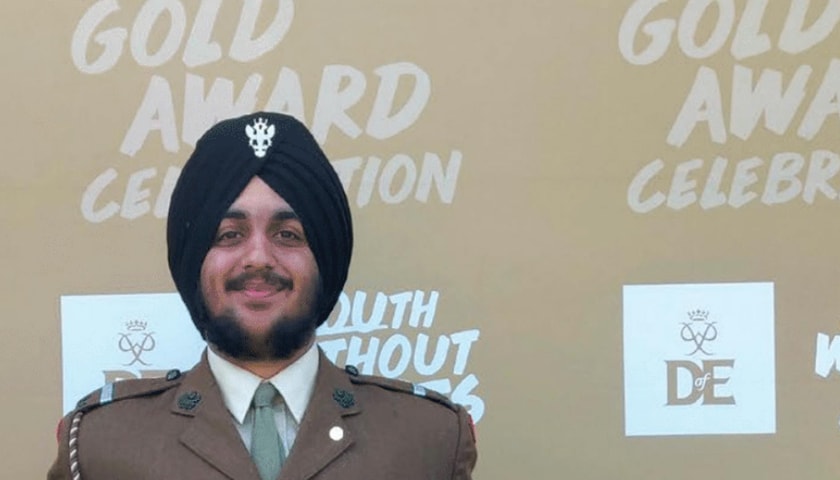
Cdt UO Harnaam Singh of Bilston Detachment, Staffordshire & West Midlands (North Sector) ACF, joined the Army Cadets in 2018.
He signed up for the DofE Bronze Award through the Army Cadets in 2020 but was thwarted by the lockdowns and disruption of the Covid-19 pandemic. By the time life had returned to normal, Harnaam was 16, so he decided to bypass the Bronze and Silver Awards and go straight for Gold.
‘By missing the Bronze and Silver Awards, I had to spend a few months longer on some sections of the Gold Award, so it took me two years to complete the five sections,’ he says.
‘It was easy to find time to do the Award though, as lots of Army Cadets activities count towards it, and I really enjoyed most of the sections, so I didn’t mind prioritising the time.’
Golden Opportunity
For the Volunteering section, Harnaam opted to develop the instructing he was already doing. Harnaam’s dad, SMI Ranjit Singh, is also his detachment commander and had encouraged his son to do some instructing, so for the Volunteering section Harnaam took this a step further.
SMI Ranjit Singh says:
‘Adults can instruct from manuals, but cadets who are further along in the Army Cadets experience can pass on useful practical information to younger cadets: what really goes on at camps, and tricks and tips to thrive during expeditions – things like using a plastic rations bag to keep your map dry, or how to whittle down the stuff you’ll carry.’
SMI Ranjit Singh is in no doubt about the value of the DofE Awards to cadets. He says:
‘I encourage all my cadets to achieve DofE Awards as the qualification is recognised all over the world, and I know they’ll have amazing experiences, push their boundaries, learn new skills and meet some fantastic people. With the Gold Award, they also have the opportunity to visit a Royal Palace to collect their award, which is a once-in-a-lifetime moment.’
Challenging Times
Both Harnaam and his father acknowledge that the Gold Award is prestigious because it is difficult and tests participants’ resilience and commitment.
‘I found some of the CyberFirst courses I chose for my Residential and Skills sections really tough and was grateful for the encouragement of my dad and coursemates,’ says Harnaam.
He was also worried about bad weather and boggy ground in the lead up to his DofE expedition, but a practice trek in Snowdonia transformed his mindset:
‘I was with a great team of people and we had lovely weather. I learnt that being positive makes a big difference – skin is waterproof, and it’s okay to stop to eat a flapjack and enjoy the view for a couple of minutes. It can help to tune into the natural beauty around you.’
SMI Ranjit Singh adds:
‘Sometimes I do feel like a third parent, nagging cadets when they lose momentum. DofE and the Army Cadets can be challenging at times, so I feel I’m here to support and encourage them. The smile on their faces when they feel a sense of achievement is the reason I do it.’
Transformative Experience
SMI Ranjit Singh volunteered to support Harnaam’s DofE qualifying expedition in Northern Ireland. He transported cadets and their kit to Ballykinler and stayed around to help.
‘One of the supervisors invited me on a walk to the highest peak,’ he says.
‘Halfway up, the weather became terrible! It was challenging but I enjoyed it and understood how the cadets felt.’
As well as supporting the development of the cadets in his detachment, he feels he has grown through his role as a CFAV. He joined the Army Cadets in 2009 as part of a community project and had no military background or knowledge of the Army Cadets.
‘I discovered that I love supporting young people to push their boundaries, explore opportunities and learn skills outside academia. I’ve also learnt a lot and met people and, as a result, am a more well-rounded person.’
Future Plans
Sharing the Army Cadets’ experience with family members can have its ups and downs, but it is mostly positive, insists Harnaam:
‘Seeing my father in his role as a CFAV, I understand the effort and sacrifice made by a lot of the CFAVs. My brother, Cpl Jujhar Singh, is also a cadet and I think the experience has brought us all closer together. I’ve learnt a lot from Dad, and I’d like to think I’ve taught him a few things from a cadet’s perspective!’
Although Harnaam is about to age out of the Army Cadets, he plans to return as a CFAV in the future.
‘I want to give back to the organisation and help cadets get the most from the experience. Dad has always urged my brother and me to grab opportunities like the DofE Awards when they arise, and I’m so glad he did. Now I want to do the same for others.’
SMI Ranjit Singh agrees:
‘I always encourage cadets – including my sons – to take advantage of everything on offer in the Army Cadets. I wish I’d known about it when I was their age, but thankfully, there are plenty of opportunities for CFAVs, too!’
Insider’s Guide to Completing Gold
સ્વયંસેવા
Participants must dedicate at least an hour a week over 12 months to help others, such as teaching, instructing or supporting their Army Cadets unit, or helping out at a local community event, club or group of their choice.
‘I’d instructed at my detachment for years, so, for this part of the award, I looked back on past instructional courses and further developed my techniques to better support the junior cadets. At one stage, I was teaching six lessons per week and assisting in areas like drill, fieldcraft, first aid and navigation.’
ભૌતિક
Participants must dedicate at least an hour a week over six to 12 months to take part in a sport or activity of their choice that will improve their physical health.
‘I opted to focus on one of my favourite sports, cricket, which I played at school and at my local club. I was playing seniors cricket, so I got to play all over the county with people who were older than me, some of whom have played for over 20 years, so it was a fantastic experience.’
કૌશલ્ય
Participants develop skills in a chosen pursuit over the course of six to 12 months.
‘I developed my cyber knowledge for the Skills section of my award and then completed the CyberFirst Advanced course for the Residential section. Cybersecurity is fascinating, and it was great to spend a few days with a brilliant group of people.’
અભિયાન
Participants undertake a self-sufficient expedition as part of a team, over four days and three nights.
‘My qualifying expedition was in Ballykinler in Northern Ireland. A low point was crossing a bog at the foot of Slieve Donard mountain – we had to take a cautious approach for about two hours, which tested our spirit and teamwork. High points were the vast mountainous landscapes, glorious sunshine and pure mountain streams.’
રહેણાંક
Participants take part in a residential activity of their choice that focuses on building relationships and achieving a group aim over five consecutive days.
‘The five-day CyberFirst Advanced course counted towards my Skills and Residential sections. I knew the Advanced course would be tougher than Defenders, but I was completely out of my depth – I’m happier outside doing fieldcraft! I reached out for help and was encouraged to continue. I’m glad I pushed my boundaries and stuck with it.’
Harnaam’s DofE Expedition Advice
- Don’t pack too much food – opt for freeze-dried meals and calorie-dense snacks like nuts, flapjacks and protein bars for energy.
- Ration-pack forks are ideal on expeditions, as they’re strong, light and long enough to reach into the corners of meal pouches without you having to get your hands covered in food.
- Water bladders are more comfortable to carry and easier to use than bottles of water.
- Don’t assume you need walking poles – I prefer to walk without them. Try them for yourself in a practice expedition, and if they don’t work for you, don’t use them.
- Practice walking with your packed bag before the expedition to help you find the most comfortable position and weight distribution.
- It can be helpful to keep a small towel clipped to your rucksack, so you can rinse and wipe your face occasionally. It’s amazing how much better it makes you feel!
- Wearing shorts (or trousers that unzip at the knee) with base-layer leggings beneath is a lighter and more comfortable combo than full-length trousers.
- Dry wet socks by carrying them on the outside of your bag. If you can’t do that, put them at the bottom of your sleeping bag overnight – as the bag warms up, the socks will dry.
- Always pack too many pairs of socks and plenty of foot powder because happy feet are key to a happy spirit on expeditions