关于自豪月的 10 个事实
骄傲的历史
All modern Pride and LGBTQ+ celebrations around the world trace their roots back to the Stonewall Riots, which took place in New York City on 28 June, 1969. Following a violent police raid on the Stonewall Inn, a gay bar located in Greenwich Village, gay and lesbian activists organised and demanded that homosexuality be decriminalised throughout the USA. The Stonewall Riots lasted six days, but they did succeed in changing public perception. In 2016, the Stonewall Inn was designated as a national monument.
On 28 June, 1970, exactly one year after the riots, the first Gay Pride marches took place in New York City, Los Angeles, and San Francisco. This first march was called the Christopher Street Liberation Day March and was very different to the Pride marches you see today. This march was a political protest and there were no floats or music. In 1999, US President Bill Clinton formally declared June to be Gay & Lesbian Pride Month. In 2011, President Obama expanded this to include the entire LGBTQ+ community, and June has since been adopted around the world as Pride Month.
Stonewall UK 现在是一家慈善机构,为全英国的 LGBTQ+ 个人和问题提供支持。.
英国骄傲月
英国每年六月庆祝骄傲节,但我们也在二月庆祝 LGBTQ+ 历史月。它们看起来非常相似,但您是否想过它们之间有什么区别?从本质上讲,这两个活动都是以那些被认定为 LGBTQ+ 的人的经历、挑战和被接受为中心。.
Pride was an organisation that grew from protest and demanded change. Pride Month concerns itself with the present and future challenges facing a range of sexual identities. In that sense, it is a forward-looking organisation, considering where we are now and where we can go.
LGBTQ+ 历史月
LGBTQ+ History Month is celebrated in February in the UK to coincide with the abolition of Section 28, a law which prohibited local authorities from ‘promoting’ homosexuality in schools. Section 28 was repealed in February 2003 and has been the focal point for LGBTQ+ History Month ever since. This makes LGBTQ+ History Month more concerned with the past and remembering the injustices that have occurred so that we can avoid repeating them in the future.
关于英国骄傲和 LGBTQ+ 历史的十大事实
1. London Pride
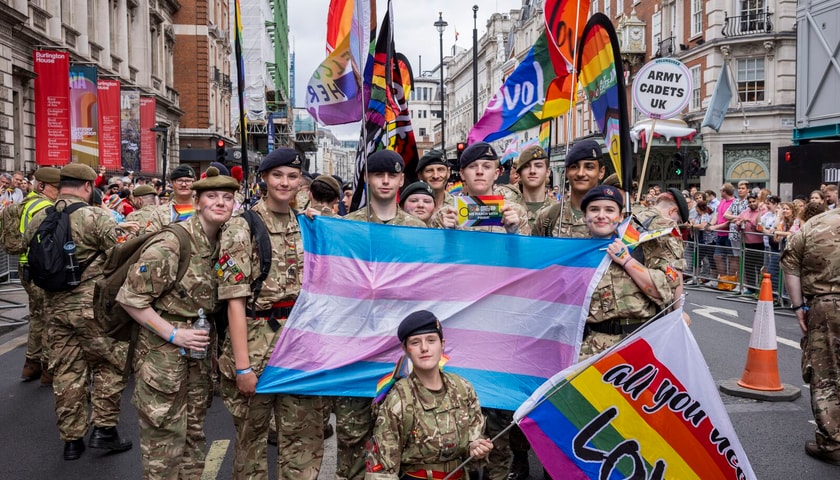
伦敦骄傲 is the UK’s biggest LGBTQ+ festival, with 2026 set to be the biggest yet. The Army Cadets attend Pride each year to take part in the parade alongside the other armed forces.
2. First UK Pride Festival
The first UK Pride Festival took place on 1 July 1972 in London. The date chosen was the closest Saturday to the date of the Stonewall Riots which occurred on 28 June 1968. An estimated 2,000 people attended the first Pride.
3. 2023 London Pride
Organisers of the 2025 London Pride Festival estimated that around 500 organisations were involved, and around 30,000 people took part in putting on the show.
4. 1967 Sexual Offences Act
In England and Wales, homosexual acts between men aged over 21 were decriminalised in the 1967 Sexual Offences Act, followed by Scotland in 1980 and Northern Ireland in 1982. This was equalised with the heterosexual age of consent to 16 in 2001. UK law has never considered female homosexuality a civilian offence. This only applied to men!
5. The Pride Flag
The familiar Rainbow Flag was created in 1978 by volunteers in San Francisco. The first flags were hand-made by dyeing and sewing fabrics. The most popular version of today’s flag contains six colours: red, orange, yellow, green, blue, and violet. The original flag concept had eight colours, including pink and turquoise, but these were later removed. Pink was not readily available in 1978, and blue replaced indigo and turquoise.
6. Alan Turing
Did you know Alan Turing, the computer genius who led the project to decode the German Enigma machines in the Second World War, was gay? Alan Turing’s work made a vital contribution to the defeat of Nazi Germany, and he has become one of the most influential LGBTQ+ figures in British history.
7. Gender Recognition Act
The Gender Recognition Act is a UK law which allows people to change their legal gender. It was passed in 2004 with strong, but not unanimous, support. In the House of Lords, it passed with 155 votes in favour and 57 against. In the House of Commons, it passed with 355 votes in favour and 46 votes against.
8. UK Marriage Equality
The UK recognised same-sex civil partnerships in 2004. Surprisingly, opposite-sex civil partnerships were not permitted at this time. Civil partnerships were a stepping-stone to full marriage equality. The law permitting same-sex marriage came into effect in 2014, and civil partnerships for opposite-sex couples have been available since 2019 in England and Wales.
9. UK Population Statistics
"(《世界人权宣言》) 国家统计局 reported in the 2021 census that 3.2% of the population, around 1.5 million people, identified as gay, lesbian, bisexual or ‘other sexual orientation’.
10. Manchester’s Sparkle Weekend
曼彻斯特的 闪亮周末 is the world’s largest free-to-attend celebration of gender diversity and is inclusive of trans and gender diverse individuals as well as friends, partners and allies of all kinds. The first Sparkle Weekend took place in 2005, and in 2025 over 10,000 people attended.
陆军士官生的多样性
原则 多样性和包容性 touch all areas of the Army Cadets, and we take our responsibilities seriously. In 2025, our National Diversity & Inclusivity Adviser, Lt Colonel Rachel Diss won the 国防包容性奖 at the Soldiering On Awards. This highlights over 15 years of Rachel’s dedication to our young people, a devotion that can be observed throughout our organisation.
与陆军军官学校一起更进一步
这包括我们至关重要的 成人志愿者 以及新学员。如果你想成为一个拥有不同技能、背景和经验的团队的一员、, 找支队 今天就在您附近。.