Famous Battles in British History
Découvrez les célèbres batailles britanniques de l'histoire. Voici l'histoire de deux victoires et d'une défaite à Agincourt, Hastings et la bataille de Stamford Bridge.
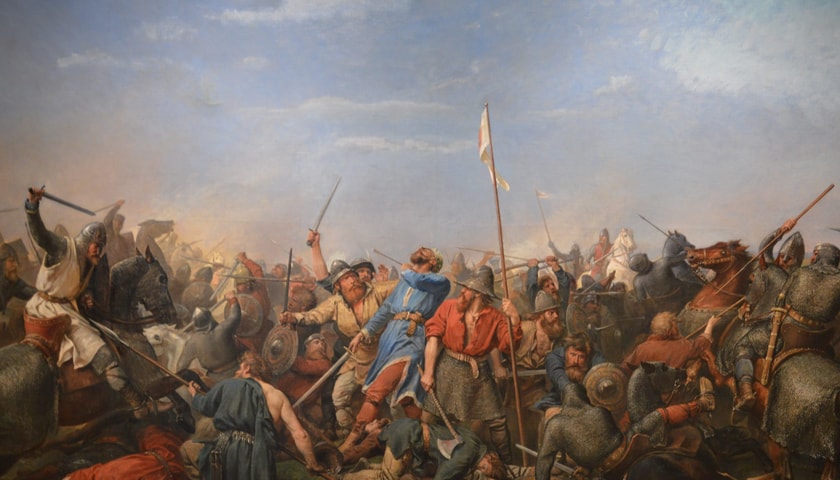
Recreation of Vikings Fighting at Stamford Bridge
Of all the famous battles that have happened throughout history, Britain has had more than its fair share.
Parmi les batailles britanniques les plus célèbres, on peut citer
- La bataille de Stamford Bridge, où Harold II a vaincu une armée nordique après avoir parcouru près de 200 km en quatre jours.
- La bataille d'Hastings, qui a établi la domination normande en Angleterre.
- La bataille d'Agincourt, au cours de laquelle le roi Henri V a vaincu une armée française supérieure en nombre.
Vous avez peut-être déjà entendu parler de l'une d'entre elles ou de toutes, mais si ce n'est pas le cas, lisez ce qui suit pour en savoir plus sur ces célèbres batailles britanniques.
Bataille de Stamford Bridge (25 septembre 1066)
Edward the Confessor’s death in January 1066 was the catalyst for a power struggle in England. The Norwegian king, Harald Hardrada, had his own claim to the English throne, supported by Tostig Godwinson, the brother of King Harold II. With Edward gone, Harald launched an invasion.
His army is often numbered at 10,000 men, but many historians estimate 7,000 to 9,000 is more realistic. While he found early success in his campaign throughout the north of the country, this would not last once news reached King Harold.
Harold II, rightly fearing a Norman invasion to establish their claim to the throne, maintained his army in the south and so was unprepared for an attack from the north. This was supported by feints (a tactical move designed to mislead or deceive an opponent) made along the south coast in early September. Harold was right to believe an attack was imminent, but he was wrong about the location.
Upon hearing the news of Harald’s invasion, Harold gathered his army and rode to Yorkshire at such a speed that his army was able to cover 185 miles in only four days. The Norwegian forces were taken by surprise, completely unaware that Harold’s forces were in the area. Crucially, the Vikings had left their heavy chainmail hauberks on their ships due to the heat, leaving them vulnerable.
The battle couldn’t start until Harold’s army crossed the choke point of Stamford Bridge. According to the Anglo-Saxon Chronicle, a single Norseman blocked the way until he was finally killed by an English soldier attacking from under the bridge.
Once across the bridge, the English attacked the Norse shield wall. Over the course of the battle, the English began to breach the wall and outflank their enemy. Norwegian reinforcements arrived later in the battle but were ineffective against the army defending its homeland. Harald and Tostig were both killed in battle, and a truce was agreed upon between Harold II and the invaders’ sons.
The Battle of Stamford Bridge signalled the end of the Viking age, but at the other end of the country, the Norman age was about to begin. Although Harold retained the field this day, his fear of Norman invasion from the south was about to be realised, and so Harold rode back south, gathering forces along the way, for what was to be his final battle.
Bataille de Hastings (14 octobre 1066)
Perhaps one of the most famous battles in British history, the Battle of Hastings in the 11th century established Norman power in England through the defeat of Harold II. The Duke of Normandy (his title before he became known as William the Conqueror) claimed the right to rule thanks to deep Norman interests established during the reign of Edward the Confessor.
Harold II, Edward’s immediate successor, contested the Norman claim. Following his victory over the Norwegian invaders at the Battle of Stamford Bridge, only weeks earlier, Harold raced south to see off this new challenge to his throne.
Records and accounts vary, but William’s forces were probably at least 10,000 strong, with a mixture of infantry, cavalry and missile troops. He deployed these into three fighting groups with archers to the front and infantry at the rear. He held his mounted troops in reserve, which historians believe was probably so they could exploit openings in the English line.
Less is known about the defending English forces. Some fanciful Norman accounts record Harold’s army as being over a million strong, but the reality is more likely to have been around 10,000 infantry, according to modern historians.
Harold took advantage of the terrain in preparing his defence, making use of a hillside to position his soldiers, while marshy ground and woods guarded their flanks. To protect themselves and each other, the tightly packed English soldiers formed a shield wall. This, plus their height advantage over the French army, frustrated the Norman archers.
The English line held against the Norman infantry and cavalry, at least at first. A rumour soon spread amongst the invaders that William had died and they began to retreat. It was William himself who stopped the retreat by riding through his forces to show them he was still alive and then turned and led the counterattack against the pursuing English forces.
Later that day, William deliberately used this same tactic by sending in his cavalry and then withdrawing. This encouraged the English to give chase and thereby introduce breaks into their line, which William could exploit in the counterattack. It seems unlikely that this would have been a viable tactic if it were not for the speed and flexibility of the cavalry. Infantry troops attacking uphill and then retreating would surely have been overrun by the English pursuit.
While the record does not show this action to have been a decisive turn in the battle, it is an established military tactic still valid on the modern battlefield. Even Sun Tzu warned against this in The Art of War: “Do not pursue an enemy who simulates flight.”
The real victory in the battle came with the death of Harold himself. Famously remembered as having been shot in the eye with an arrow, the real cause of his death is still unknown. Although the Bayeux Tapestry does show a soldier with an arrow in his eye, he has not been positively identified as Harold.
Without Harold’s leadership, the English army began to flee. Only his royal guard, who formed a wall around Harold’s body, stayed to fight till the end. The Normans were ultimately victorious.
William’s victory over Harold shows the value of how courageous leadership, cunning tactics and the flexibility of combined arms can defeat an entrenched defensive position—and perhaps a little bit of luck.
The connection between the Battle of Stamford Bridge and the Battle of Hastings
Although these were two separate battles, they were only separated by a few weeks. They were both part of a larger defensive campaign undertaken by the English. The quick succession of battles against the Viking and the French armies was too much for English forces to overcome. The loss at Hastings and the impact of the Norman rule changed England forever with the introduction of French culture and the feudal system. Remnants of the feudal system can still be seen today, 1,000 years later, in areas like leasehold land ownership and titles used in the House of Lords.
Bataille d'Agincourt (25 octobre 1415)
Four hundred years later, English armies again fought the French. The Battle of Agincourt in October 1415 remains one of the most famous British battles and impressive victories of all time. William Shakespeare even used it as the backdrop for part of his play, Henry V.
L'un des nombreux événements de la guerre de Cent Ans (1337-1453), le principal incident d'Agincourt est la revendication d'Henri V sur l'Aquitaine par son arrière-grand-père Édouard III. Ouvert à la négociation sur le territoire, Henri propose de renoncer à ses prétentions pour le prix de 1,6 million de couronnes et de se marier avec Catherine, fille de Charles VI, ce qui inclut une dot de 2 millions de couronnes supplémentaires. Henri refuse la contre-offre française, qui réduit la dot à seulement 600 000 couronnes, considérant leurs conditions comme une insulte. Finalement, avec l'appui du Grand Conseil, Henri entre en guerre.
When Henry’s army reached Agincourt on 24 October 1415, they had marched 260 miles in under three weeks and found themselves greatly outnumbered. The French, anticipating the arrival of more troops, attempted negotiations to delay the battle. Henry declined and ordered preparations for the battle.
L'armée anglaise compte alors environ 8 500 hommes, dont 7 000 archers. Henri organise ses forces en plaçant les troupes de missiles en longues lignes sur les flancs et les chevaliers et hommes d'armes au centre. La tactique anglaise innovante consistait à utiliser des pieux aiguisés devant les archers pour repousser les chevaliers attaquants et les concentrer au centre.
Les estimations de la taille de l'armée française varient, mais la plupart des récits s'accordent à dire qu'elle comptait au moins 15 000 combattants. Elle comprenait deux forces de cavalerie, l'une pour briser le centre anglais et l'autre pour harceler l'arrière de l'Angleterre. Les seigneurs français, en quête de gloire et de précieuses rançons, exigent des places en première ligne et les obtiennent.
Si la bataille s'était déroulée en terrain découvert, l'histoire aurait pu être très différente. La cavalerie française aurait pu se déplacer plus librement sur le champ de bataille. En l'occurrence, le terrain, les conditions météorologiques et les tactiques ont favorisé les Anglais.
The initial French charge was so disorganised that some of the Knights did not even take part as they weren’t ready. English archers were able to shoot at this charge from both flanks and be well-protected by their defensive fortifications. The French horses, almost entirely unarmoured, took the brunt of these missiles. The injured animals panicked and fled through the French soldiers, causing more disruption. Then came the French assault on foot by Knights far better protected from the longbows thanks to their high-quality plate armour. They reached the English line but were exhausted by their march through the muddy conditions, and they struggled to fight in their heavy armour.
Bien qu'à court de flèches, les archers anglais n'avaient qu'une armure légère et étaient mieux armés pour affronter la boue. Ils tombèrent sur les chevaliers français avec leurs épées et leurs outils, les submergeant et brisant l'attaque française. En conséquence, ce n'était qu'une question de temps avant qu'Henri V ne revendique la victoire.
Agincourt shows how better tactics and positioning, as well as some fortunate rain, can help an outnumbered and tired force to defeat a numerically superior opponent, which should, in theory, have carried the day.
Aller plus loin avec les cadets de l'armée
How different would these English battles have been if the armies knew what we know today? Modern communication and information systems, artisanat de terrain and even first aid courses would completely change ancient battlefields. No matter your ambition, the Programme des cadets de l'armée can help you prepare for any challenge. Find your nearest detachment today.