LNR ACF Shines at Exercise Rolling Thunder 2025
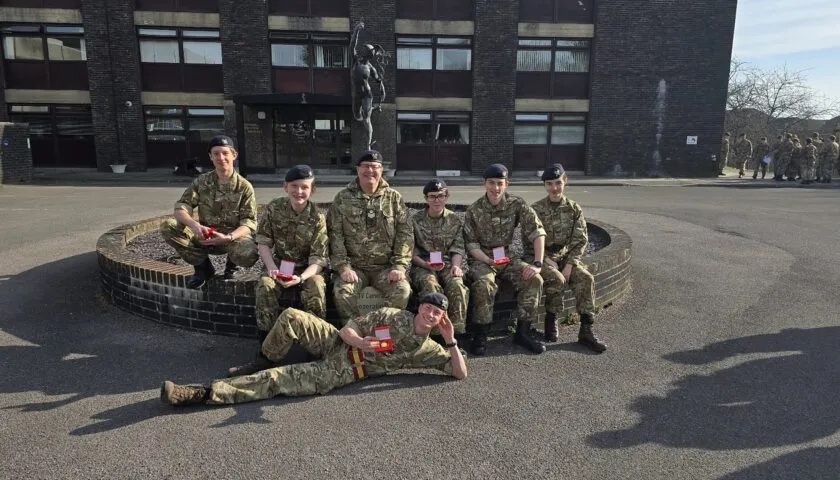
Exercise Rolling Thunder is a premier CIS competition held at Blandford Camp, Dorset. Five cadets from B (Tiger) Squadron Signals Detachment took on the challenge, showcasing their skills in radio, cyber, and observation tasks against top competitors.
Exercise Rolling Thunder 2025
Exercise Rolling Thunder is an annual Communication and Information Systems (CIS) competition run by the Cadet CIS Training Team (CCISTT) at Blandford Camp, Dorset, the home of the Royal Corps of Signals. This year, five members of B (Tiger) Squadron Signals Detachment, under the supervision of SSI Cook and Sgt Jefimova, were chosen to represent LNR ACF:
- Cdt Sgt Challis – Wigston Detachment
- Cdt Cpl Siedlarz – Wigston Detachment
- Cdt L/Cpl Cook – Brentwood Road Troop
- Cdt L/Cpl Cyrankowski – Wigston Detachment
- Cdt Nash – Wigston Detachment
On 7th March, the team met at Tigers Road for the four-hour journey south, eager to experience Exercise Rolling Thunder and have some fun. While the competition had a maximum capacity of 20 teams, only 10 entered this year. On Friday evening, all teams gathered in the lecture theatre at Blandford for a briefing before getting some rest in preparation for the challenges ahead.
The Competition Begins
Saturday morning started with a hearty breakfast in the cookhouse before teams received a quick briefing and set off for their first stand. Over the course of the day, they tackled six stands, with assessments and scoring conducted at five of them.
Stand 1 – Communications Centre (Comcen)
Two communications centres were set up, and the team had to pass messages via radio or data link to the other comcen, logging all messages and using intelligence collected to solve a puzzle. Thanks to excellent logging skills from team captain Cdt Cpl Siedlarz and perfect voice procedure from Cdt L/Cpl Cook, the team scored highly in this challenge—an impressive start.
Stand 2 – Cyber
This stand involved a cyber-themed board game, where two teams competed against each other. Players rolled dice to move across themed spots, answering cybersecurity-related questions. Cdt L/Cpl Cyrankowski demonstrated great knowledge in answering the questions, while Cdt Sgt Challis’ dice-rolling skills left a little to be desired!
Stand 3 – Reporting
The team was deployed to an observation post (OP) to track and report on the movements of the fictional Dr. Alexander Vex, who was planning to use weaponised neurotoxins and high-energy laser strikes against UK military installations. They sent sighting reports via radio, encoded using Battle Code (BATCO), but were eventually spotted and had to withdraw while sending a contact report. Thanks to Cdt Nash’s keen observational skills, the team successfully identified the weapons being used and determined which neurotoxin was being transported—an outstanding effort in ensuring the ‘safety’ of the nation!
Stand 4 – PRC 710 Familiarisation
The PRC 710 is the platoon-level VHF radio used by cadets. Due to battery issues, these radios had been out of service for over a year, limiting cadet training opportunities. Fortunately, the CCISTT was the first to replace the batteries, allowing cadets to get hands-on experience and successfully complete this element of the 2-Star CIS syllabus.
Stand 5 – Radio
Stranded behind enemy lines, the team had to navigate the area, collecting hidden radio equipment left behind by underground operatives. Each equipment cache was locked with a combination padlock, with the code securely transmitted using BATCO. Once all items were retrieved, the team assembled the PRC 715 and erected an elevated ground spike antenna on a 5.4m mast to transmit a BATCO message to a receiving station.
Stand 6 – Voice Procedure
The final stand tested the team’s ability to pass messages over a heavily congested radio network, requiring creative problem-solving to relay situation updates back to headquarters. As expected, chaos ensued, but this was a deliberate part of the exercise—demonstrating the importance of clear voice procedures and strict radio discipline in challenging conditions.
Conclusion
Following a well-earned social evening on Saturday, Sunday was dedicated to presentations before the long journey home. The team performed exceptionally well for their first participation in the event, securing an impressive third place. They were only beaten by two teams that have dominated the competition for several years.
More importantly, the team bonded exceptionally well, supporting one another and playing to each other’s strengths. They should be incredibly proud of their achievement. With this experience under their belts, we look forward to competing again next year—stronger, wiser, and ready to climb even higher on the leaderboard!