Antarctic Odyssey Achieved
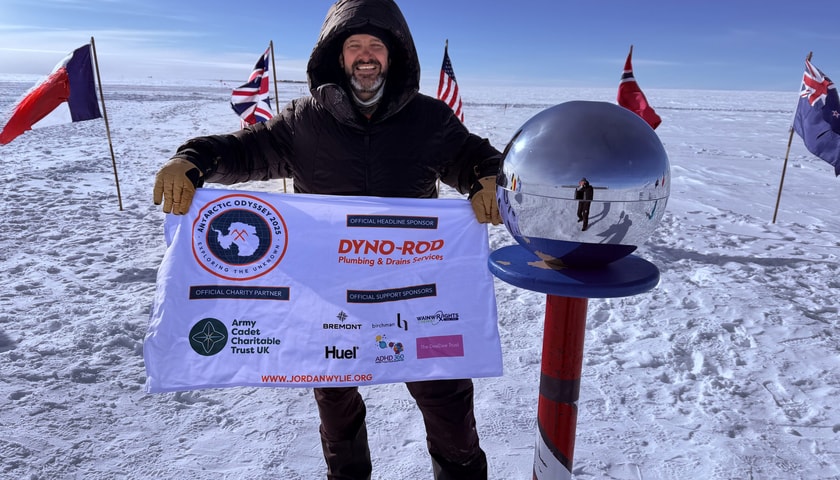
In December 2025, Jordan Wylie skied across one of the most hostile environments on Earth to conquer three unclimbed peaks for his Antarctic Odyssey challenge. On achieving this extraordinary, trailblazing feat, the adventure could easily have stopped there. However, the Army Cadets National Ambassador decided to push himself even further: he strapped on skis again and, in temperatures as low as -31°c, continued another 60 nautical miles to the South Pole.
Extreme environment
For the best part of a month, his Antarctic Odyssey challenge turned out to be a brutal test of both body and mind. Antarctica threw everything it had at him: extreme cold, relentless wind, whiteouts and isolation. Then there was the mental challenge of spending long periods in one of the most unforgiving environments on the planet.
‘One of the hardest aspects was the mental battle,’ dit-il. ‘When you’re pulling a pulk (sled) for 10-12 hours every day in temperatures well below freezing, fatigue can creep in quickly.’
Change of plan
Some of the most difficult moments came during the harshest weather conditions, when visibility dropped, the wind picked up and the cold felt relentless.
‘Antarctica has a way of reminding you very quickly who is in charge,’ dit-il.
As with all expeditions undertaken in extreme environments, staying flexible and adjusting to new circumstances became an essential part of the survival toolkit.
‘Weather conditions, terrain and safety considerations meant adapting plans in real time,’ says Jordan. ‘There were a couple of days when I couldn’t move due to whiteout conditions.’
Another stoppage occurred when Jordan’s team members needed to be evacuated; they were all required to stay in one place for a full day so the rescue team could locate them.
‘On my expedition to the South Pole, only two of the five who started made it all the way. It was a low moment when some of my teammates had to be evacuated due to fatigue.
‘In Antarctica, you must respect the environment and make decisions based on safety and survival rather than sticking rigidly to the original plan. Preparation helps, but adaptability is what ultimately gets you through.’
Once they were safe, Jordan continued his journey and skied on to the South Pole with former SAS officer and polar legend Louis Rudd MBE.
Staying resilient
One useful strategy that helped Jordan keep going was breaking everything down into manageable steps: simple things like focusing on the next kilometre, the next checkpoint and the next task.
‘It’s a mindset the cadets learn as well: discipline, routine and teamwork,’ dit-il. ‘Even when I was physically alone, I carried with me the core values and lessons learnt from the military and the Army Cadets.’
South Pole success
All the hardship was worth it. Jordan describes reaching the South Pole as an incredibly emotional experience.
‘It was a moment of reflection, thinking about the journey, the people who supported me and the young people I hoped the expedition would inspire,’ dit-il.
He’s also very grateful for the many magical moments he experienced along the way.
‘What a privilege to be able to experience complete silence, vast untouched landscapes and the incredible feeling of being somewhere very few people have ever been.’
Unexplored territory
During the challenge, Jordan found it humbling to be the first to summit previously unclimbed and unnamed peaks and to traverse unexplored territories.
‘Antarctica is one of the last true wildernesses left on Earth,’ dit-il. ‘Knowing you are trailblazing through areas no human has experienced before gives you a profound respect for the environment.
‘There’s also a strong sense of responsibility to protect these fragile places and to tell their story, so future generations understand their importance.’
Pushing through to inspire young people
Antarctic Odyssey began with a simple but powerful idea: to push beyond perceived limits and demonstrate what can be achieved through training, preparation and resilience.
‘For me, it was never just about the adventure. It was about using the challenge as a platform to inspire young people, and especially cadets,’ says Jordan. ‘I want them to believe that extraordinary things are possible if you are willing to work hard, prepare well and keep going when things get difficult.’
Fundraising for the Army Cadets
The expedition was also about giving back. Antarctic Odyssey raised awareness and funds to support young people, particularly through ACCT UK (Army Cadet Charitable Trust UK).
‘In the last two years (and to date) well over £100,000 has been raised from my adventures, which I am really proud of,’ says Jordan. ‘For me, adventure should always have purpose. If a challenge can inspire young people, raise funds for opportunities and shine a light on positive role models, it becomes about something much bigger than the individual taking part.’
Final reflections
Jordan would be the first to tell you that the challenge turned out to be more gruelling than he could have envisioned.
‘You can train for years, plan meticulously and prepare for every scenario, but the environment still finds ways to challenge you,’ dit-il.
‘The biggest surprise was how mentally demanding it was. The monotony, isolation and physical strain combine in ways that test your resilience. Some days, the landscape was so white it was difficult to identify the land from the sky; there was no horizon.
‘On reflection, though, those particularly difficult times were also the moments I feel I grew the most as a person.’
Xtreme Everest
Army Cadets National Ambassador Jordan Wylie MBE reveals plans for his next thrilling and gruelling challenge, Xtreme Everest.
Jordan can reveal that his next epic expedition will be called Xtreme Everest: a multi-layered challenge combining adventure, endurance and youth development.
‘The journey will begin far below sea level at the Dead Sea, the lowest point on earth, before travelling thousands of miles overland across the Middle East and Asia to Nepal,’ dit-il. ‘The expedition will then culminate in an attempt to summit Mount Everest.’
An exciting part of the project is that ten cadets from across the UK will be selected to join the expedition during the Everest Base Camp phase.
‘It will be a once-in-a-lifetime opportunity for those cadets to experience the Himalayas, learn about leadership and resilience, and be part of something truly extraordinary and a world-class expedition,’ says Jordan.
Get involved
This new expedition will also support ACCT UK, helping create opportunities for cadets across the country.
‘One of the most exciting elements of Xtreme Everest is that it’s not just about reaching the summit, it’s about taking young people on the journey with us.’
‘Cadets will be able to follow the expedition, learn about the planning, training and logistics of a major adventure, and hopefully be inspired to pursue their own challenges.’
Jordan has plans to create educational content, leadership lessons and opportunities so cadets can engage with the expedition as it unfolds.
‘The aim is to show that big adventures don’t just belong to explorers – they belong to anyone with determination, curiosity and the courage to try.’