An Interview with: National Honorary Colonel Lorraine Kelly
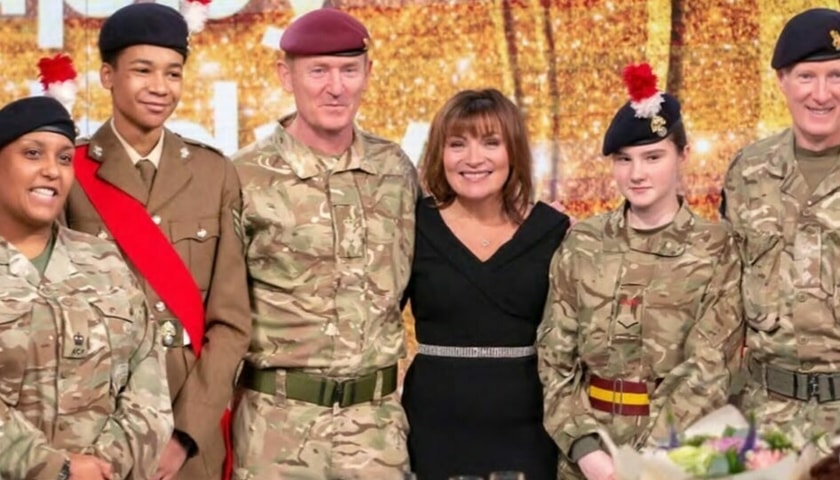
Lorraine Kelly has been our National Honorary Colonel since 2020. Here she reveals what it was like to be (unexpectedly) presented with the title on live TV, and why being a cadet gives young people skills for life.
No one who watched Lorraine on her special 60th birthday TV programme last November could have failed to tear up at the genuine emotion she displayed when Colonel Stuart Williams OBE asked her to be the Army Cadet’s new National Honorary Colonel.
‘Seriously?’ she asked with huge surprise, followed by a tearful: ‘Gosh. I am so honoured, I really am.’
Army Cadets Interview with Lorraine Kelly
What are your memories of that morning?
‘I was so emotional. They did it live on the show and, of all the things that went on that morning, that was the one that touched me most. It was a massive, massive honour.
‘I feel that part of my job now is being an ambassador for the cadet movement and letting everyone know how fantastic the volunteers are. We wouldn’t have the movement if it wasn’t for them giving their time, energy, enthusiasm and passion: they’re astonishing.’
What are your memories of the cadets?
‘I would love every single young person in the country to have the opportunity, should they so choose, to be a cadet as it would give them a lot of confidence.’
A long-time supporter of the military (she’s also an ambassador for Help for Heroes), Lorraine’s formal relationship with the Army Cadets started in 2009 when she was made Honorary Colonel of the Black Watch Battalion ACF in Scotland.
‘I loved doing that. Like a lot of people, I had never realised just what amazing work was being done, so it was wonderful for me to get that opportunity in Scotland. What I really noticed was that while not everyone who joins the Cadets goes on to be in the Armed Forces, everyone who joins the Cadets will be a better person for it – and be better at whatever they go on to do in life.
‘I love the friendships that are made and the sense of togetherness, which is exactly what we need at the moment. All the ways we are told we should live our lives right now are the values which are essential to the cadet experience: being the best you can be, showing community spirit, being generous, being kind. They’re all values that cadets have and hopefully, when this is over, the world will be more like the Cadet movement.
What does she think Army Cadets gives young people in terms of qualities, skills and values?
‘It’s being a more caring and considerate person who thinks about others, and about developing self confidence,’ she says. ‘Those skills set you up for life, no matter what you decide to do.
‘It’s also about community – and that’s never been more important. It’s about thinking about others and helping others, maybe in a practical way. It doesn’t have to be huge: it could be going to get someone the paper or checking in on them. Putting others first is important – if we all did that, what an amazing world it would be.’
She also sees teamwork as a key cadet quality:
‘You’re only as good as the weakest link in your chain, so it’s important to make sure that everyone gets the help that they need. Everyone has different skills: maybe you’re academic but you can’t put a plug on, but your pal can, or maybe someone else has good leadership skills. When you pool those skills together it’s powerful.’
Did she have an opportunity to develop those kinds of skills when she was young?
‘I was in the Brownies and the Girl Guides and, of course, it’s not exactly the same (and back then it was quite different to how it is now) but anything that requires you to be part of a group is great.
‘Cutbacks have meant we don’t have so many youth clubs nowadays and the Army Cadets fills that gap. Anything that takes you away from being self absorbed and makes you part of a team is helpful.’
What values does she live her life by?
‘When I was a kid I was taught “do as you would be done by”. That sounds very old fashioned but we were taught to help others and that we had a social responsibility, so that’s certainly something I try to do.
‘We all have to help in our own way. I’ve volunteered as an NHS Volunteer Responder and, while I’m not able to drive people around, I can listen if people want to talk on the phone.’
Despite doing what may seem to be a pretty glamorous day job, Lorraine is keen to emphasise that her life off-camera is somewhat different:
‘As soon as I come off air, it’s on with the jeans and trainers,’ she laughs. ‘I’m actually a pretty adventurous person. I went to Antarctica a few years back and followed in the footsteps of Ernest Shackleton which was incredible – I even did a polar dip (crazy, but it had to be done).
‘I like a challenge: I’ve done four marathons – three London, one New York. I also did a hundred-mile trudge through the desert in Kenya for charity, which was very tough but an amazing experience.’
If she’d been born a little later, her career might have been very different, as her girlhood ambition was to be a pilot in the RAF.
‘Back then it was so bloody sexist they wouldn’t let girls do that. I wasn’t able to fulfil my ambition to be a pilot but, because of my job, I’ve been up in a couple of jets – including a Tornado, which was amazing.
‘It’s never been easier for girls than it is now – we’ve come so far. And the same goes for people who are gay or trans – and it’s brilliant to see. I’m so encouraged by the number of young women who are in the Cadets.’
So what advice does the National Honorary Colonel have for Cadets?
Be Respectful
‘We don’t honour our military personnel enough,’ continues Lorraine. ‘It’s the same with the NHS: we take them for granted until our life or the life of someone we love is on the line.
‘If I see someone in uniform I always make a point of thanking them for their service. I know it’s very American but I think it’s important. One thing that I think will come out of this experience is that we won’t take the NHS, Armed Forces, other first responders or those brilliant people who empty the bins for granted again. They are literally putting their life on the line. It’s very humbling.’
Get Outdoors
‘If you’re not lucky enough to have a garden, try and get out to the park once a day.’
Get inspired to get outside and explore the world with our series on great British explorers featuring Девід Лівінгстон, Джеймс Кук, Sir Frances Drake, і Сер Ранульф Файнс, і inspiring female explorers.
Help your Community
‘In our street we set up a WhatsApp group so we can help each other and look out for the elderly. My husband set it up and he’ll go out and get their shopping. Then on another day a different neighbour will do it. It’s about seeing what you can do – while staying safe.
See how the Army Cadets can help you take a bigger part in your community.
Communicate
‘Talk to your friends using one of the many video apps and, if you have got wobbles (and I’ve certainly had wobbles), make sure you talk about them. If you don’t feel you can talk to your parents, make sure you talk to your pals. That’s where those friends you’ve made at Cadets really come into their own.’
Take the opportunity to learn new skills
Maybe learn a language or a new skill and put the time to use. If your mum’s asking you to do some jobs and DIY, try and help. I also think that watching things which are a wee bit more uplifting is helpful.
Learn skills employers will love, і learn to appreciate the skills you have.
Приєднуйтесь до армійських кадетів
Learn valuable new skills, make new friends, challenge yourself, and, most importantly, make a difference in your local community. It’s easy to register your interest, just знайти загін і заповніть форму "Висловлення зацікавленості", і ми зв'яжемося з вами для отримання більш детальної інформації про те, як стати волонтером у нас!